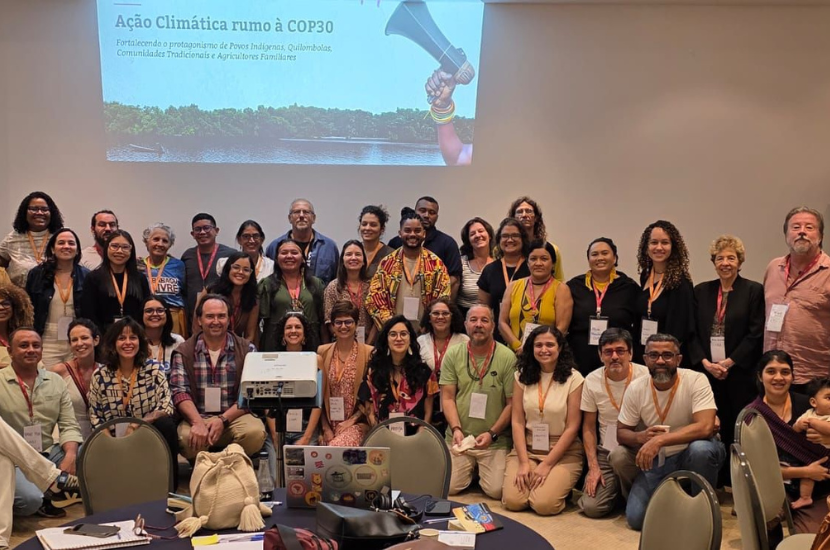
Engagement, change makers and climate governance
Climate change already has a severe impact on Brazil’s most vulnerable territories. Because they safeguard strategic environmental assets, Indigenous peoples, quilombolas, and traditional communities play a central role in biodiversity conservation and in addressing the climate crisis. Faced with increasingly frequent extreme weather events, strengthening the adaptation and resilience of these populations has become an absolute urgency.
Given this scenario, the Engagement, Agents of Change, and Climate Governance Core Area strengthens social participation and supports place-based adaptation solutions. iCS strategy links governance to the strengthening of traditional communities, community-based adaptation, and social mobilization, ensuring climate policies that are more legitimate, effective, and aligned with local realities.
Strengthening Indigenous peoples, Quilombolas, and traditional communities (PIQCTs) in climate action and governance
Support institutional strengthening, territorial protection, access to climate finance, and the meaningful participation of Indigenous peoples, Quilombolas, and traditional communities in local, national, and international climate governance forums.
Approach:
- Strengthening of territorial organizations and leadership;
- Support for the management and protection of territories;
- Expanded access to climate finance;
- Participation in decision-making and climate governance processes;
- Integration of traditional knowledge and scientific evidence.
Strengthening territories through community-based adaptation
Promote adaptation solutions built upon the priorities, knowledge, and capacities of the communities themselves, strengthening the resilience of vulnerable territories in the face of climate impacts.
Approach:
- Support for community-led adaptation solutions;
- Strengthening of local capacities;
- Integration of climate data and local knowledge;
- Development of solutions for water security, resilience, and risk reduction;
- Generation of evidence to inform public policies.
Communication
and Mobilization
Approach:
- Support for innovation in climate communication;
- Development of new narratives and language;
- Mobilization of diverse audiences;
- Strengthening popular and territorial communication;
- Production and dissemination of evidence-based climate information.
Team
Grants
To develop a narrative intelligence lab to analyze, test, and disseminate evidence-based climate communication strategies, focusing on countering AI-driven misinformation and engaging audiences resistant to climate discourse. The project integrates knowledge production, stakeholder mobilization, and mass communication to expand the reach and effectiveness of environmental messaging in Brazil.
To combat deforestation, the project aims to create a mosaic of indigenous lands, the Mirador Mosaic, surrounding the Mirador State Park in Maranhão. The project will conduct a diagnosis of the socio-environmental and cultural reality of the populations, strengthen understanding and dissemination of the proposed creation, and work with environmental and indigenous affairs agencies to achieve its formal recognition.
To support the indigenous peoples of Roraima and their leaders in responding to climate change by building awareness tools, case studies, and climate change mitigation plans, and by expanding their participation in political advocacy spaces at the regional, national and international levels, within the spaces of climate advocacy and governance by 2026.
To make the climate agenda part of everyday life by placing climate and gender at the center of entertainment. The project maps real stories of women, analyzes their emotional architecture, and translates them into narrative profiles and principles. Through research, expert immersion, and pilot testing, it develops and validates a replicable methodology for the climate and creative ecosystems.
To broaden the scientific impact of the “Belém Adaptation Indicators” and foster implementation strategies that develop unequal urban territories, especially in the Northeast and North of Brazil, the project will promote a cycle of strengthening governance and institutional technical capacities through communication and scientific dissemination in climate adaptation.
The project aims to promote an agenda that integrates technical strengthening, multi-level political advocacy, and regional coordination to consolidate a platform for collective intelligence, a benchmark in climate adaptation from the Amazon, and to expand local capacities, evidence production, and territorial leadership.
To strengthen broad and diverse participation of social movements, traditional peoples and communities, urban populations from the Amazon and Global South organizations in the People’s Summit at COP30, by supporting logistics and popular communication, with a special focus on the global climate march, which became the largest climate mobilization in Brazil’s history.
To promote a training process for Quilombola leaders in the state of Tocantins to develop a climate adaptation plan. It will conduct training workshops, map perceptions of climate change and the strategies adopted by communities for adaptation, promoting exchanges, strengthening and disseminating community practices
To support Indigenous associations and leaders in Indigenous lands in Acre to influence climate policies, strengthen and implement adaptation measures that prepare communities to avoid and reduce the impacts of climate change. The project will support political advocacy activities, the development of an adaptation plan, and the strengthening of Indigenous communication.
To create community-based actions focused on territorial protection, climate adaptation, and the economic sustainability of women-led initiatives, this project aims to support institutional strengthening, provide training and capacity-building, and develop communication strategies to promote community practices and exchanges as real solutions to combat climate change.
To support climate adaptation actions with Indigenous peoples and traditional communities in Amazonas and Mato Grosso, contributing to the development of local plans to address extreme climate events, strengthening the Pirarucu Collective for sustainable commercialization, and promoting inclusive public policies.
To mobilize faith communities to confront environmental racism by expanding the presence of Black evangelical leaders at COP30. The project strengthens the existing Acácias network, promoting training, articulation, and political advocacy, using the launch of a manifesto for climate justice, faith, and representation as a key tool.
To strength the political education of Black and peripheral youth from São Paulo’s North Zone to connect local experiences with global climate decisions. The project creates the Brasilândia Climate Rights Charter, which will be presented at COP30 by a young representative from the territory.
To strengthen APIB and APOINME to ensure Indigenous leadership in climate decision-making, with a focus on climate justice and access to climate finance. The project has four main pillars: (i) international legal advocacy; (ii) strategic communication; (iii) institutional strengthening; and (iv) qualified participation in climate negotiations.
To leverage mobilisation and advocacy strategies in territorial policies and actions that consider basic sanitation as a climate adaptation tool, the project will present, disseminate, and encourage the implementation of adaptation alternatives for more sustainable, safe, and resilient futures, highlighting proposals for city models that reduce inequalities.
To strengthen local initiatives that integrate food sovereignty, socio-environmental justice and foster community leadership, the project aims to boost food sovereignty in 15 communities in Maranhão, benefiting around 500 people, The project will promote agroecological practices, solidarity economy, education and communication for integral ecology, strengthening 12 associations supported by REPAM, with 58 dioceses in the Amazon.
To create community-based actions focused on territorial protection, climate adaptation, and the economic sustainability of women-led initiatives, this project aims to support institutional strengthening, provide training and capacity-building, and develop communication strategies to promote community practices and exchanges as real solutions to combat climate change.
To develop a knowledge production laboratory focused on climate literacy, targeting communicators and journalists from independent media outlets based in the outskirts, favelas, and traditional communities of the metropolitan regions of São Paulo, Rio de Janeiro, and Belo Horizonte.
To secure approval of legislation against aerial spraying of pesticides and to leverage actions and public policies for the sustainable agroecological transition, the project aims to strengthen communities, especially youth, through capacity-building and support for local development grounded in climate justice and the management and protection of traditional ways of life.
To mobilize religious leaders, youth, Indigenous peoples, and social movements in interfaith vigils for climate justice is the focus of ISER’s Faith in Climate project. The initiative will travel through several Brazilian capitals and culminate in the Vigil for the Earth during COP30, on November 13th in Belém.
To create and promote unified actions in 2025, in conjunction with organizations and coalitions that collaborate in the construction of recreational, political-pedagogical, coexistence, and educational spaces, the project will promote connected actions to translate information on the topic of climate adaptation and foster debate on actions in urban spaces and sociobioeconomics as an adaptive measure.
To address the challenge of climate impacts exacerbating inequalities in the North and Northeast of Brazil, particularly for children and young people, this project aims to enhance training and promote strategic campaigns that foster territorial climate adaptation and the participation of these groups in national climate policy, thereby ensuring intergenerational equity in climate action.
To strengthen the consolidation of an autonomous movement for the protection of the Amazon, expanding its mobilization base, national and international advocacy towards COP30, and institutional capacity. The project aims to engage territories and networks across Brazil to press for concrete commitments in defense of the Amazon’s forests and peoples.
To strengthen the climate agenda in Bahia and boost local political advocacy, the Rizoma Project will coordinate community communication, strengthening local radio stations, content production and advocacy. The project invests in training local agents from peripheral areas, focusing on women, young people and black leaders to transform narratives and strengthen community networks.
To promote initiatives focused on the resilience of peripheral territories and young leaders in the Xingu/Pará region, this project will develop training activities incorporating climate and environmental education strategies, and implement local climate solutions, such as training in management and cultivation techniques, to ensure food security and reduce socioeconomic vulnerability.