
Degraded pasture is one with low quality or incapable of producing grass to feed livestock in order to provide them with the quantity and quality of grass necessary to maintain the meat or milk production. When degraded, the soil ends up being taken over by weeds or is totally devoid of vegetation. With the soil poor in nutrients, the rural producers cannot use the land to raise livestock or for agriculture. This ends up putting pressure on the opening of new areas and, consequently, for deforestation, if they intend to expand their production.
However, the condition of degradation is reversible. To recover these areas, the Ministry of Agriculture and Livestock (MAPA) launched, in December 2023, the National Program for the Conversion of Degraded Pastures into Sustainable Agricultural and Livestock and Forestry Production Systems and (PNCPD), through Decree 11,815. This decree also established an Interministerial Steering Committee with the function of forming technical groups to promote debates about sectoral policies to implement the PNCPD.
The objective of the program is to promote public policies and financial incentives that make degraded areas productive once again. Currently, the size of the pasture areas with some degree of degradation in the country is around 107 million hectares. The goal is to recover 40 million hectares of pastures within 10 years, which would make it possible to double the area of food production in the country without the deforestation of a single hectare of native vegetation.
In order to participate in this initiative, the rural property must be registered with the Rural Environmental Registry (CAR) and present a project to produce with fewer emissions or an increase in its capacity to absorb greenhouse gases, through means of environmentally and socially sustainable practices. The National Bank for Economic and Social Development (BNDES) will be partner of MAPA in the raising of funds, preferably external, in order to finance the projects.
Implementing the PNCPD also depends on coordination work with each of the Brazilian states, with the mapping of the degraded areas and the economic viability of possible activities in each region, among other activities to be carried out under the supervision of the Interministerial Steering Committee.
More sustainable economic activity and financing with lower interest rates
In order to contribute to accelerating the PNCPD, iCS, within its strategy to promote regenerative agriculture, brought together partners such as the Center for Intelligence and Governance of Land and Sustainable Development (Cite), the Public Policy Group of Esalq and Agroicone to gather information about the degraded areas in the country and, in this way, to provide initial support to MAPA.
“This survey estimated the potential for the conversion or recovery of degraded pastures into sustainable agricultural and livestock and forestry systems. We also assessed whether the lands have a CAR that does not overlap with areas of restricted use, such as Full Protection Conservation Units, Indigenous Lands and Military Areas. Based on these analyses, we arrived at 87.8 million hectares that can be recovered,” explains Kamyla Borges da Cunha, coordinator of the iCS food systems and climate initiative.
“Of this total, 40.7 million hectares, equivalent to 1.8 million properties, are in compliance with the Forest Code, with no deforestation having occurred since 2008. These are the areas that are capable of being financed with low interest rates. Considering that more than half of these properties belong to small and medium-sized producers, the impact on income generation is enormous,” she says.

With the mapped data, it was possible to note that 79% of these degraded pasture areas of the properties that could participate in the PNCPD are in nine states: Bahia, Goiás, Mato Grosso, Mato Grosso do Sul, Minas Gerais, Pará, Rondônia, São Paulo and Tocantins.
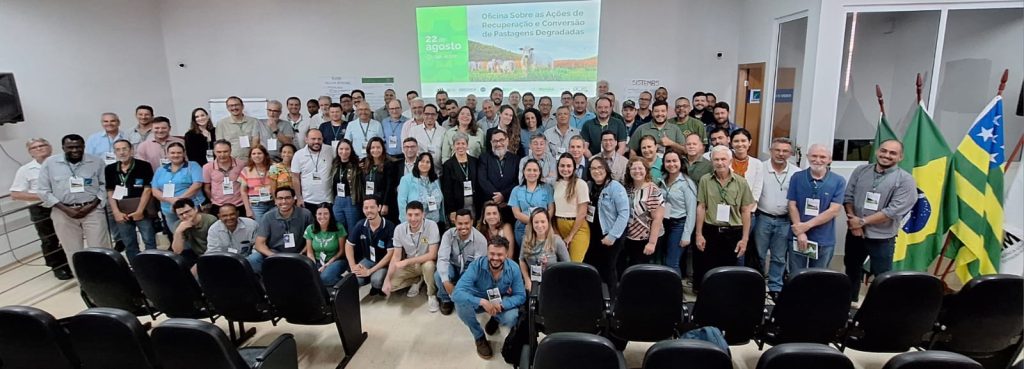
The group assembled by iCS, in partnership with the Department for Sustainable Development, Irrigation and Cooperativism (SDI), held a workshop in each one of the nine states in order to identify the state policies for the recovery and conversion of the degraded areas, to discuss the capabilities of each state for the implementation of economic activities in these areas and to identify priority actions and regions, generating a specific diagnosis.
The Olab and Colab consultancies joined the already assembled partners in the organization and carrying out of the workshops, which involved around 400 people in total, made up of representatives from the environmental and agriculture and livestock departments of each one of the states, as well as local and regional entities representing agribusiness and rural producers, civil society organizations and research institutes.
For the Secretary of Environment and Water Resources of Tocantins, Marcelo Lelis, it was essential, as a first step for the program, to unite the different local actors to hear about their needs in relation to the recovery of the degraded areas.
“Here in the state, the Environment and Agriculture departments work together, promoting the development of profitable and sustainable actions for agriculture and livestock. Therefore, participating in an event that discusses a subject of extreme interest to producers from Tocantins is of fundamental importance, including for the environmental policy in the state,” he said in an interview with the MAPA website.
For Francisco Manzi, a cattle breeder from the region of Cuiabá (MT) and the technical director of the Mato Grosso Cattle Breeders Association (Acrimat), the workshop was positive because it promoted an exchange of ideas. “This type of discussion is an opportunity to hear what other sectors think, such as the government and civil society organizations, as well as to express what we are thinking. Even if the interests and objectives may be different, it is through these conversations that we can reach the points that unite us,” he says.

Based on the listening experience promoted by the workshops, iCS prepared nine summary documents with the results – one for each state with data about the degraded areas and potential activities to recover them, previously analyzed for each region, and a summary of the promoted dialogues.
Identified markets and balance of emissions
Manzi, who has around 200 head of cattle, says that more important than the availability of financing for the recovery and conversion of the degraded areas is the creation of a market for what will be produced in these locations. “Most cattle breeders know how to avoid degradation and what to do to recover it. However, for small farmers, obtaining financing or investing out of their own pocket in the recovery does not make sense unless there are also some economic advantages. If you want to increase production, you need to have somewhere to sell it,” he says.
In this regard, beyond understanding the most indicated activities for the recovery and conversion in each region – intensification of beef or dairy farming, conversion to agriculture, forestry, agroforestry systems or integrated systems (such as crop and livestock integration or crop, livestock and forestry) –, the survey carried out by the group of organizations took into account, among other factors, the structure for the production to be absorbed by the market. For example: are there slaughterhouses within a short distance that could buy the meat, avoiding long-distance transportation, which would increase carbon emissions?
In addition to market suitability and availability, the carbon balance calculation is being made for each one of the activities. “For a specific region, what will be the greenhouse gas emissions from transforming degraded pasture into an area that is suitable for agriculture? And how much carbon will be removed with the planting of grains? This is the balance that we will present for each suggested activity,” says Isabel Garcia- Drigo, the director of the program Climate, Land Use and Public Policy at Imaflora. “With this data, MAPA will be able to talk with each state and decide on the best transition in the land use, considering the value of what will be produced and the balance of the emissions,” she explains.

With all the data being made available, Lizane Ferreira, the deputy secretary of SDI, at MAPA, says that the program will be accelerated. “The work carried out by iCS and its partners has placed us on another level with the quality of the information about the areas. We now have accurate data to present to the Interministerial Steering Committee, which will speed up and facilitate decision-making,” she says. “This contribution was also very well received by the states, which now have accurate maps, which allows for the intervention in the priority areas from a social, environmental and economic point of view.”
For iCS, the work does not end when the implementation of the program begins. “We see the degraded pastures as a catalytic opportunity for public and private investment and the integration of public policies for regenerative agriculture and livestock activities, recovery and bioeconomy, generating, at the same time, more employment, an increase in income in the field and environmental conservation,” says Kamyla Borges.